Design is about to become one of the cheapest things a creative business can sell.
Think about it.
You can open an AI tool right now and generate a logo in seconds. Give it another few minutes and you'll have a brand identity, social media templates, product mockups, and a functioning website.
Some of it will look surprisingly good.
For a business owner who would previously have spent thousands on those deliverables, that's a pretty compelling proposition.
And I think businesses should take advantage of it.
But there's something about this whole conversation that reminds me of coffee.
Instant coffee has existed for well over a century. It's convenient, inexpensive, and takes seconds to prepare.
Yet people still go out of their way to visit specialty coffee shops. They pay considerably more for something they could make at home for a fraction of the price.
Why?
Sometimes it's the quality. Sometimes it's the experience. Sometimes it's the barista who knows exactly how to make something you enjoy, or who introduces you to something you wouldn't have thought to order.
- Seconds to make
- Costs very little
- Good enough for plenty of people
- Made to a standard
- An experience you choose
- Someone who knows what to suggest
Of course, plenty of people are perfectly happy with instant coffee. And for what they need, it's a great solution.
I think creative services are heading in a similar direction.
AI is making creative production accessible to almost everyone. That's a good thing. But businesses still need to understand when convenience is enough, when expertise improves the outcome, and when the wrong creative decision could become a costly business problem.
01The short answer: When should you use AI instead of a creative agency?
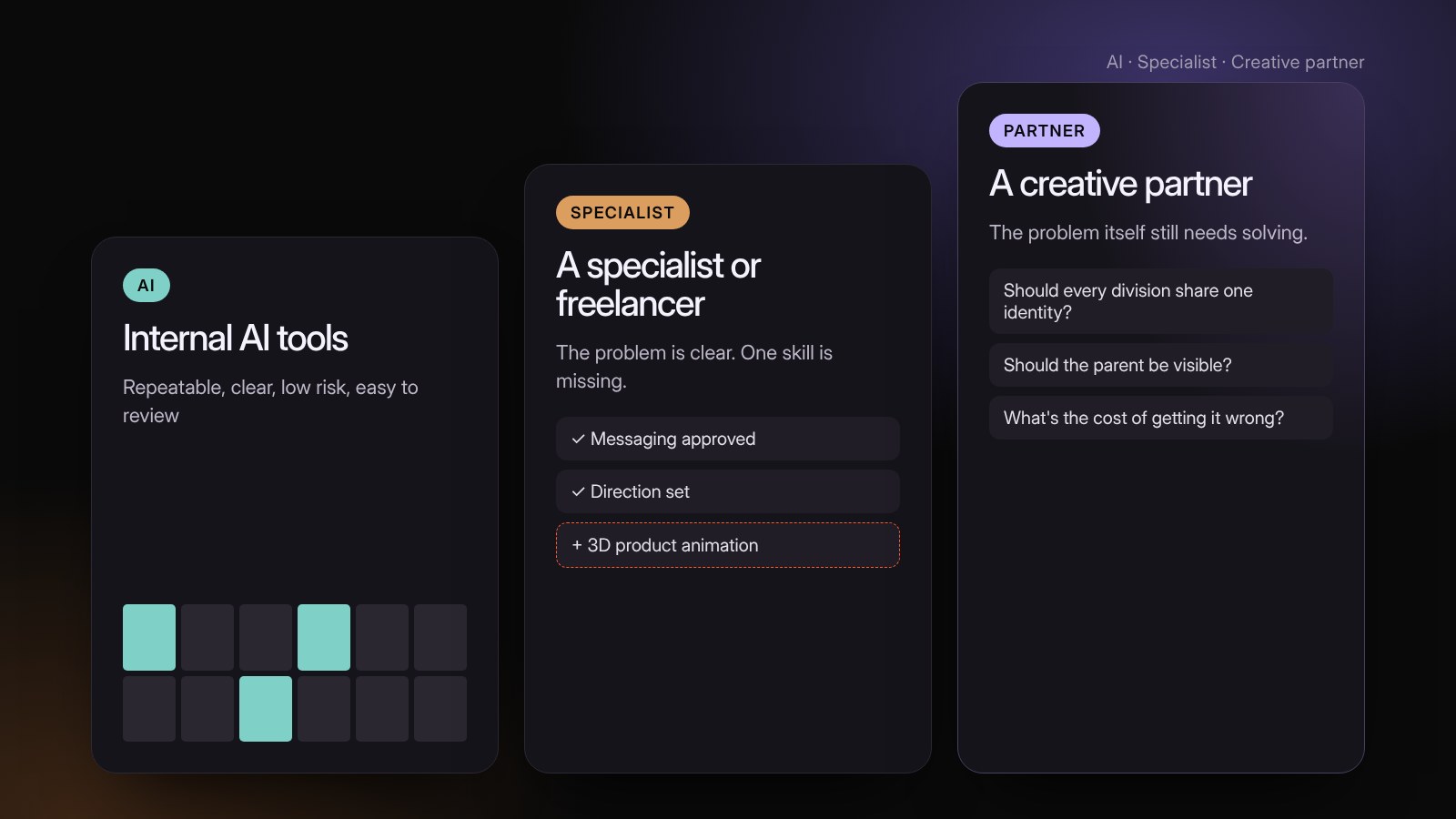
Use AI internally when the task is repeatable, the requirements are clear, the risks are low, and your team knows how to evaluate the result.
Hire a specialist when you know exactly what needs to be done but lack a particular skill.
Bring in an experienced creative partner when you're still figuring out what the right solution should be, when several disciplines need to work together, or when getting it wrong could meaningfully affect your business.
- AI
Use AI internally
when the task is repeatable, the requirements are clear, the risks are low, and your team knows how to evaluate the result.
- SP
Hire a specialist
when you know exactly what needs to be done but lack a particular skill.
- CP
Bring in an experienced creative partner
when you’re still figuring out what the right solution should be, when several disciplines need to work together, or when getting it wrong could meaningfully affect your business.
- All three, each where it belongs
For many established businesses, the best option will be a combination of all three.
The important thing is knowing where each one belongs.
02AI is already changing what businesses expect from creative agencies
This conversation isn't hypothetical anymore.
In a March 2026 survey by CXL and Wynter, among the marketing leaders surveyed:
- 27%
reported replacing parts of agency work with AI.
- 40%
expected agencies to deliver faster because of AI.
- 20%
reported shifting spending toward strategy.
Source: CXL and Wynter, March 2026
These findings don't represent every marketing department, but they illustrate an important shift in buyer expectations.
Businesses are questioning what they're paying for.
If an agency previously charged substantial fees for basic copy variations, image resizing, or routine asset production, its clients now have good reasons to challenge those costs.
And agencies should be prepared to answer those questions.
9 in 10 US marketing agencies were already using generative AI. Forrester, June 2026
According to Forrester’s June 2026 research, nine in ten US marketing agencies were already using generative AI. Forrester also warned that an excessive focus on efficiency could come at the expense of creativity and differentiation.
That's where things get interesting.
Producing more creative work has become easier. Producing work that genuinely improves a business still requires knowing what you're trying to accomplish.
A company can generate thirty advertisements in an afternoon.
But who decided what those advertisements should say? Who identified the audience? Who checked whether the offer was compelling? Who knows what to change when the campaign underperforms?
The ability to create thirty options is useful.
The ability to identify the three worth testing is where experience starts to matter.
03AI, freelancer, or creative agency? The three ways to approach creative work
Before allocating your next marketing or branding budget, I'd divide the work into three categories.
1. Internal AI tools
Repeatable tasks with clear requirements and straightforward review
Social media variations, product descriptions, adapting existing assets
2. Specialist or freelancer
A defined problem requiring particular expertise
Motion graphics, specialist illustration, video editing, a specific development task
3. Creative partner
Ambiguous, consequential, or multidisciplinary business problems
Brand positioning, brand architecture, major website redesigns, integrated brand and film projects
See the full table
| Approach | Best suited for | Example |
|---|---|---|
| 1. Internal AI tools | Repeatable tasks with clear requirements and straightforward review | Social media variations, product descriptions, adapting existing assets |
| 2. Specialist or freelancer | A defined problem requiring particular expertise | Motion graphics, specialist illustration, video editing, a specific development task |
| 3. Creative partner | Ambiguous, consequential, or multidisciplinary business problems | Brand positioning, brand architecture, major website redesigns, integrated brand and film projects |
These aren't rigid categories.
An experienced internal brand team may be perfectly capable of leading a major rebrand. A talented independent strategist may solve a positioning problem without an agency. And an agency can be an unnecessarily expensive choice for a simple production task.
The difference usually comes down to how clearly the problem is defined and how much expertise your business already has.
Use AI when you already know what good looks like
Imagine your business has an established brand identity.
You know your target customers, your tone of voice, your product positioning, and your visual guidelines.
Now you need twenty product descriptions, variations of an existing campaign, and social media graphics for the coming month.
This is exactly where AI becomes useful.
You have an established direction. You can provide clear instructions. Your team can review the output against existing standards.
Paying an external creative team to recreate every small asset may add very little value.
The deciding factor is whether someone on your team can confidently approve the result.
If that expertise exists internally, you may not need outside help.
Hire a specialist when the problem is clear but the skill is missing
Suppose your marketing team has already developed a campaign.
The messaging is approved. The visual direction is established. You know where the campaign will run.
But you need a sophisticated 3D product animation.
You probably don't need a full creative agency to reconsider your brand strategy.
You need someone who is excellent at 3D animation.
The same applies to specialist photography, sound design, illustration, copywriting, and technical development.
A well-defined brief combined with the right specialist can be incredibly efficient.
And that specialist may use AI extensively as part of their workflow.
Their value comes from knowing how to produce, direct, refine, and deliver the work to an appropriate standard.
Hire a creative partner when the problem itself needs solving
Now imagine a family-owned business has spent twenty years building a successful manufacturing operation.
Over time, it's expanded into several industries. Different divisions have their own identities, websites, sales materials, and ways of describing the company.
Management decides it's time for a rebrand.
You could ask AI to generate a new corporate logo.
It would probably give you something presentable.
But that logo doesn't answer the questions the business actually needs to resolve.
- Should all the divisions share the same identity?
- Should the parent company be visible to customers?
- How should the company communicate its scale to investors?
Should all the divisions share the same identity? Should the parent company be visible to customers? How should the company communicate its scale to investors while allowing individual brands to remain distinct?
Those decisions have consequences across the entire business.
A new logo might be one of the final deliverables. The work that determines what that logo should represent happens much earlier.
That's the kind of problem where an experienced creative partner can be valuable.
04The six questions that should determine your decision
If you're deciding whether to use AI or hire external expertise, I'd evaluate your project against six factors.
For each factor, pick the side that describes it.
Choose a side for each factor to see where the work belongs.
Keep the work internal. If the answer is yes across the board, keep the work internal.
Hire the missing skill. If you only have one missing technical skill, hire that skill.
Bring in broader expertise. If you’re uncertain about several fundamental decisions, particularly on a high-stakes project, bringing in broader expertise starts making sense.
See the full table
| Factor | AI or internal team may be enough when… | External expertise becomes more valuable when… |
|---|---|---|
| Strategic clarity | You know the problem and the intended result | You’re uncertain what needs to change |
| Cost of failure | Errors are inexpensive and easily corrected | Mistakes could affect revenue, trust, or a major launch |
| Differentiation | Following established brand guidelines is sufficient | Your business needs a distinctive position |
| Internal expertise | Your team can evaluate and improve the work | Nobody internally has the relevant experience |
| Frequency | The work is recurring and predictable | It’s an occasional project requiring concentrated expertise |
| Integration | The deliverable stands largely on its own | Brand, website, film, content, and customer experience must work together |
Here's a useful way to apply that table.
For each factor, ask whether your business already has the knowledge, capacity, and accountability to manage it.
If the answer is yes across the board, keep the work internal.
If you only have one missing technical skill, hire that skill.
If you're uncertain about several fundamental decisions, particularly on a high-stakes project, bringing in broader expertise starts making sense.
And perhaps the most important question is this:
What's the cost of getting this decision wrong?
- A poor social media graphic can be replaced tomorrow.
- A poorly structured website could confuse customers for months.
- A brand architecture mistake can create expensive inconsistencies across multiple businesses, products, and markets.
A poor social media graphic can be replaced tomorrow.
A poorly structured website could confuse customers for months.
A brand architecture mistake can create expensive inconsistencies across multiple businesses, products, and markets.
The price of producing the creative work is only one part of the equation. You also need to account for internal review time, revisions, implementation, and the consequences of an ineffective result.
05Four real-world situations where the decision changes
You need product content for 200 SKUs
You have accurate product information, clear positioning, existing photography, and established brand guidelines.
Use it to develop descriptions and content variations, then have someone review factual claims, consistency, and suitability before publishing.
External support becomes more useful if the underlying product positioning or content system needs to be developed first.
Start with AI internally.
Your business is launching three new brands
You’re expanding into new product categories and aren’t sure whether each product should have an independent brand or sit under the parent company’s identity.
You need to understand the relationship between your businesses, how customers make decisions, and what each brand should communicate.
AI can help with research, competitor mapping, naming exploration, and visual references.
But the underlying decisions need to be tested against your actual business strategy.
Invest in brand strategy before commissioning identities.
Your website looks outdated and isn’t converting
You might be tempted to ask AI to build a modern replacement.
But before doing that, ask why the existing website isn’t performing.
- Is the positioning unclear?
- Is the navigation confusing?
- Are visitors struggling to find information?
- Is the offer weak?
- Or is the problem technical performance?
Is the positioning unclear? Is the navigation confusing? Are visitors struggling to find information? Is the offer weak? Or is the problem technical performance?
A new interface won’t automatically resolve those issues.
If the problem is simply outdated design and your team understands the requirements, an AI-assisted internal redesign could be sufficient.
If the problem involves positioning, user experience, conversion, content, and development, a broader team may be more appropriate.
Diagnose the customer journey before choosing how to rebuild the site.
You want to produce a brand film with AI
AI-generated video has improved dramatically, making previously expensive visual concepts possible on much smaller budgets.
But producing footage is only one part of filmmaking.
In October 2026, director Cassandra Brooksbank documented how she resurrected a previously shelved AXE commercial concept using AI.
The result was an independently produced, unofficial spec advertisement.
What I found interesting was her process.
She developed a treatment, cast synthetic characters, designed locations, planned lighting, created storyboards, directed the generated performances, edited the film, and worked with a cinematographer on finishing.
- 01Treatment
- 02Synthetic cast
- 03Locations
- 04Lighting
- 05Storyboards
- 06Directed performances
- 07Edit
- 08Finishing with a cinematographer
AI made execution more accessible, but the project still involved extensive filmmaking decisions.
For transparency, Brooksbank was also working as a creative director with Absurd, the AI filmmaking platform used for the project. Her account demonstrates one production workflow, rather than proving that every AI-generated film requires a professional director.
Still, it’s a useful example.
A simple internal explainer might be produced entirely by your marketing team.
A flagship brand film representing your company to customers, investors, or international partners deserves more deliberate creative supervision.
Match the level of direction to the importance of the film.
06What should you expect from a creative agency that uses AI?
This is where I'd encourage businesses to raise their expectations.
If you're hiring a creative agency in 2027, you should expect it to have a thoughtful approach to AI.
You should also expect to understand how that approach improves your project.
Faster exploration is valuable. So are reduced repetitive production work, better-informed research, and the ability to evaluate more creative possibilities.
But you should be skeptical of an agency whose entire pitch is that it can now generate more content.
More content isn't automatically more effective.
An experienced creative team should be able to explain why it recommends a particular direction, which alternatives it rejected, what evidence informs its decisions, and how it intends to evaluate the outcome.
It should also be transparent about where AI is being used and how the work is checked.
That includes factual accuracy, visual consistency, intellectual property considerations, confidentiality, and the ownership of final deliverables.
And if AI has genuinely made part of the work faster or cheaper, it's reasonable to ask how those efficiencies are reflected in the proposal.
You shouldn't be paying yesterday's production costs for a workflow that's fundamentally changed.
Illustrative, not to scale
Equally, a lower production cost doesn't guarantee a lower total project cost if the work still involves research, strategy, specialist direction, testing, and implementation.
Judge the full scope.
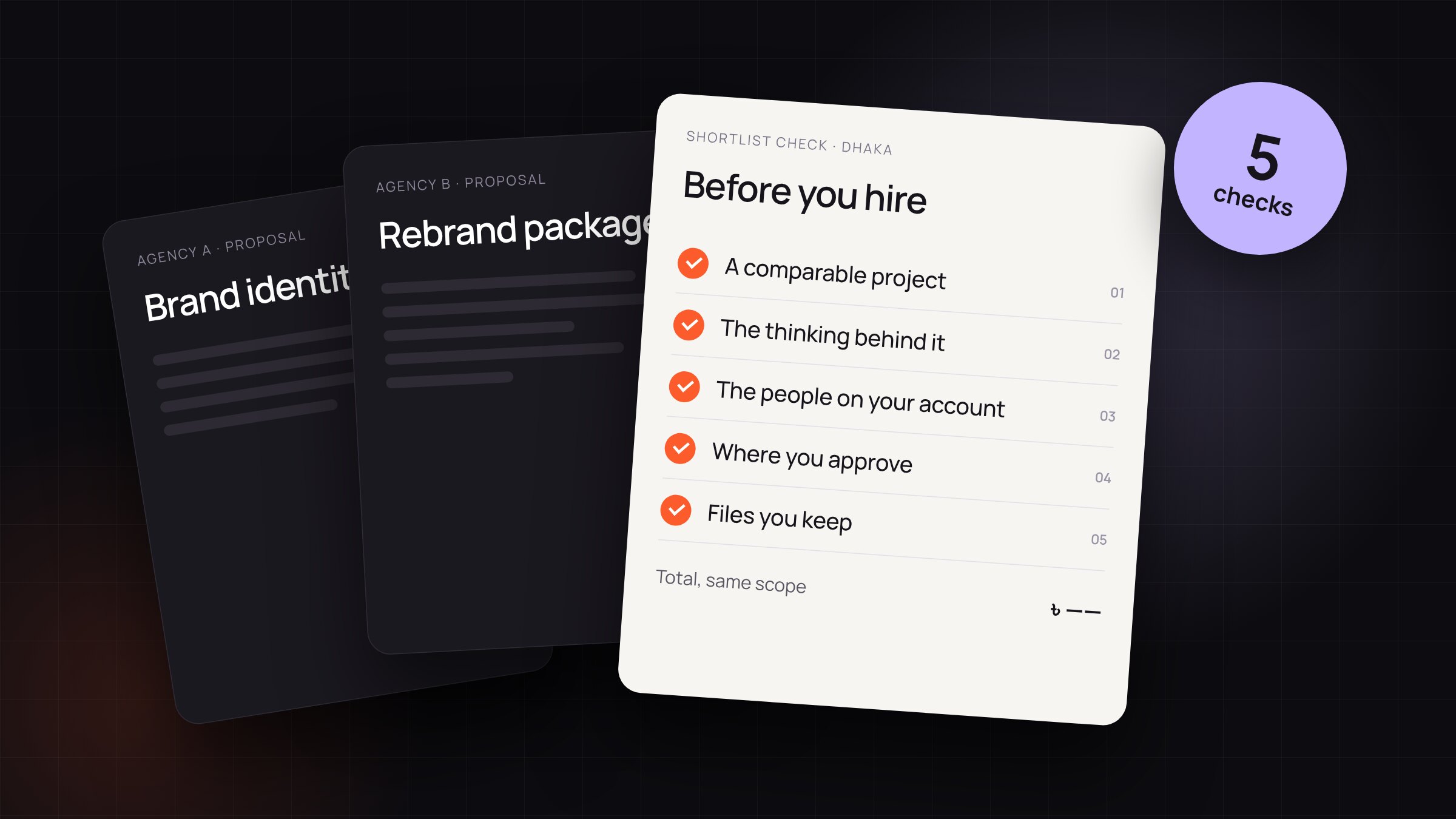
07Six questions to ask before hiring any creative agency
Before signing your next branding, website, or creative production contract, ask these questions.
How will you determine what our business actually needs?
Look for a discovery process that examines your business, customers, objectives, and existing problems before proposing deliverables.
Which parts of this project will you use AI for?
A credible partner should be comfortable explaining its workflow, including where automation saves time and where it doesn’t belong.
Which decisions require specialist creative direction?
Ask who is responsible for strategy, visual direction, user experience, technical decisions, and final creative approval.
Who reviews and takes responsibility for the work?
You should know who’s accountable for quality and how factual, technical, brand, and creative issues will be resolved.
How will we know if the project worked?
The answer depends on the project. A website might be judged on usability, qualified enquiries, or conversion. A brand identity might be evaluated through recognition, consistency, and its ability to function across applications.
Avoid vague promises of guaranteed business growth.
What exactly will we receive and own?
Clarify deliverables, source files, usage rights, intellectual property, documentation, revisions, and how your internal team will maintain the work afterward.
- How will you determine what our business actually needs?
- Which parts of this project will you use AI for?
- Which decisions require specialist creative direction?
- Who reviews and takes responsibility for the work?
- How will we know if the project worked?
- What exactly will we receive and own?
If an agency struggles to answer these questions, an impressive portfolio alone shouldn't be enough to convince you.
08The future probably belongs to businesses that combine both
I run a creative and technology company, so you might expect me to argue that everyone still needs an agency.
I don't believe that.
I think AI is going to eliminate the need for plenty of work that businesses previously outsourced.
And some of that work probably should have been handled internally all along.
A competent marketing team with good brand guidelines and effective AI workflows can accomplish an enormous amount.
At the same time, I think we'll see a growing distinction between companies that can produce creative assets and companies that know how to make consequential creative decisions.
Businesses will have access to more tools, more options, and more output than ever.
That abundance creates another problem: deciding what deserves attention.
Imagine reviewing fifty possible brand directions instead of five.
Without a clear strategy, you haven't necessarily made the decision easier. You may have made it harder.
An experienced creative partner should help reduce that uncertainty, then deliver and implement the chosen direction effectively.
At The Wider Collective, that's how we approach projects across brand, film, and websites.
- 01Understand the business problem
- 02Develop a direction
- 03Explore and refine solutions
- 04Carry decisions into production and implementation
We start by understanding the business problem, develop a direction, explore and refine solutions, and then carry those decisions into production and implementation.
Technology helps us move through parts of that process more efficiently. The expertise of the people making the decisions remains central to the work.
09So, do you still need a creative agency in the age of AI?
Sometimes, absolutely.
Sometimes, you don't.
- AI
If your business already knows what it needs and has the people to evaluate the results, use the tools available to you.
- SP
If you need a specific skill, hire a specialist.
- CP
And if you're about to make a decision that could affect how customers understand your business, how your brands fit together, or how people experience your company, consider whether additional experience could make the outcome substantially better.
Which brings me back to coffee.
Instant coffee will continue to serve millions of people perfectly well.
And specialty coffee shops will continue to have customers who value the craft, care, and experience behind what they're buying.
The same creative tools will increasingly be available to everyone. What people can accomplish with them will still vary enormously.
Going into 2027, I'd spend less time comparing the price of a design and more time understanding the value of the decisions behind it.
That's where I'd put my money.
10Frequently asked questions
Can AI replace a creative agency?
AI can replace or reduce the need for certain agency services, particularly routine content creation, asset adaptation, and clearly defined production tasks. It can also support research, ideation, design, and development. Whether it can replace an agency for a particular project depends on the complexity of the work, the expertise available internally, and who will take responsibility for the result.
Is AI-generated branding good enough for a business?
It can be, particularly for smaller businesses with simple requirements and limited budgets. However, growing companies with multiple products, customer segments, or markets may need a more comprehensive approach to positioning, brand architecture, and identity systems. A professional-looking logo alone doesn’t establish whether a brand is strategically effective.
Is using AI cheaper than hiring a creative agency?
For many straightforward tasks, yes. But the full cost should include staff time, software, review, corrections, implementation, and potential rework. External expertise may be worth the investment when it helps avoid an expensive mistake or delivers specialist capabilities that would be inefficient to build internally.
When should a company hire a branding agency?
Consider hiring a branding agency when your business is entering a new market, launching an important product, restructuring multiple brands, repositioning itself against competitors, or struggling with an unclear or inconsistent identity. First establish whether you need a comprehensive strategy or simply execution support.
Can our internal marketing team use AI and work with a creative agency?
Absolutely. In many cases, this is an effective arrangement. Your internal team can manage recurring content, routine updates, and AI-assisted production while an external partner helps with strategy, specialist creative work, complex projects, and periodic reviews. Define responsibilities and approval processes clearly so both teams contribute to the same objectives.
Need help deciding what your business actually needs?
At The Wider Collective, we work with businesses on brand strategy and identity, film, websites, and digital experiences.
If you're planning a rebrand, launching into a new market, or reconsidering how your business presents itself, we'd be happy to understand the challenge before recommending a solution.